
You are not eating badly. You are eating a plate built to feed a household.
After 40, muscle needs a bigger single dose of protein to respond. Most Indian vegetarian days fall short on distribution, not on food: most of the protein arrives at dinner, in small amounts, attached to a lot of starch.
Fixing it takes three changes, not thirty: a protein anchor at breakfast, a protein anchor at the 5 p.m. tea, and a thicker dal at dinner.
| Meal | Plate | Protein |
|---|---|---|
| Breakfast | 2 aloo parathas, tea with sugar | ≈ 9 g |
| Lunch | 3 rotis, dal, sabzi, salad | ≈ 20 g |
| Evening | Biscuits and tea | ≈ 3 g |
| Dinner | 2 rotis, rice, rajma, curd | ≈ 22 g |
| Day | Roughly 1,900 kcal | ≈ 54 g |
Around half of a sensible target — and only one meal carried enough protein at once to matter.
Two numbers, four protein slots, one family pot.
Work out your protein target (1.2–1.6 g per kg) and choose a calorie track. Every day has four protein slots — breakfast, lunch, evening, dinner. The dishes are the same on all tracks; only carbohydrate and fat portions change. One pot of dal, three different plates.
Smaller-framed women, mostly sedentary days, or a deliberate fat-loss phase.
The default: average-build women who train, and men losing fat gradually while training two to four times a week.
Larger or taller men, physically active work, or a priority on building strength and muscle.
After two weeks, adjust from weekly averages and how you feel — the book gives a simple table for what to change.
One new habit a week.
Establish
A protein anchor at breakfast, every single morning.
By Sunday: less mid-morning snacking.
Distribute
Fix the 5–6 p.m. slot — no more tea and biscuits.
By Sunday: a calmer dinner appetite.
Strengthen
Three resistance sessions, booked like meetings.
By Sunday: the same weight feels lighter.
Own it
Build two days entirely yourself from the recipe library.
By Sunday: you stop needing the book to hit your number.
Day 1, Monday.
Each day names the dish, its recipe number and the portion for each track. Swap any meal for another from the same recipe chapter, as long as the protein is within five grams.
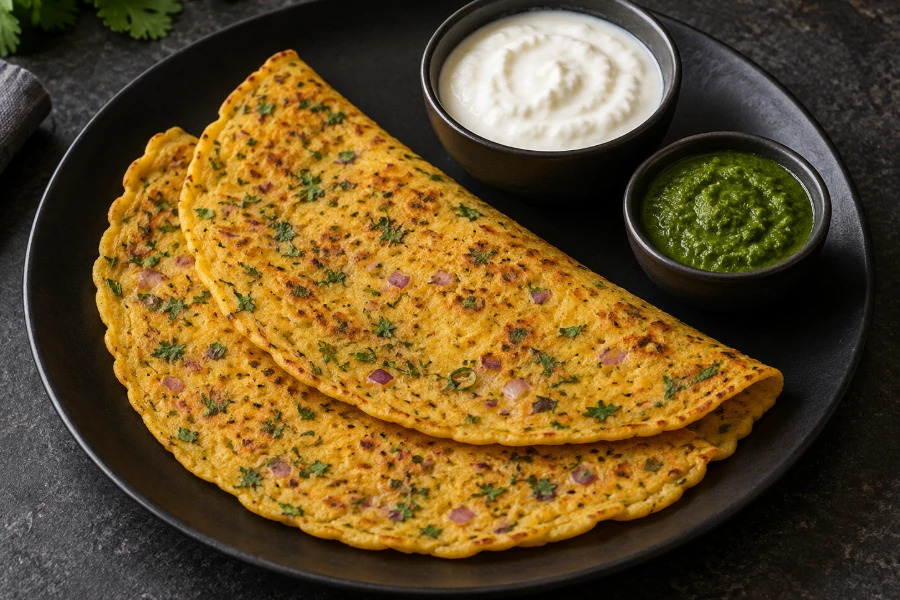
Besan chilla with mint chutney and curd (R1) · Day 1 breakfast27 g protein · 385 kcal
| Meal | Dish | Protein* |
|---|---|---|
| Breakfast | Besan chilla, 2 no., with mint chutney and curd (R1) | 27 g |
| Lunch | Thick chana dal with palak, sabzi, salad (R21) | 31 g |
| Evening | Roasted chana with onion and lemon, tea without sugar (R55) | 9 g |
| Dinner | Dry-roasted paneer with capsicum, mixed sabzi, curd (R34) | 36 g |
| Day total | 103 g |
*Track B figures. Track A runs 2–4 g lower, Track C 2–4 g higher. All values are estimates calculated from IFCT 2017.
Five parts, complete in one PDF.
Breakfasts that carry 22–30 grams.
Six of the twelve morning recipes. Every recipe carries the same nutrition strip, per serving.
Besan chilla with mint chutney and curd
Protein 27 g385 kcal15 minMoong dal chilla with paneer filling
Protein 29 g400 kcalSoak the night beforeSoya granule upma
Protein 24 g370 kcalDairy-freePaneer paratha, dry-cooked
Protein 28 g430 kcal20 minSattu paratha with curd
Protein 26 g420 kcalBihari classicThick curd bowl with oats, seeds and fruit
Protein 25 g360 kcalNo cookingWho it suits
- Healthy adults of roughly 40–60, women and men
- Lacto-vegetarian households — dairy, pulses, soya; no eggs, meat or fish
- People who want to hold muscle while reducing body fat, or build strength
- Families: nothing is “diet food” cooked separately
- Vegan readers, using the dairy-free chapter and swap table
What it isn’t
- Not a personalised or medical diet
- Not a workout program — it includes training and recovery guidance only
- No crash dieting, detox or promises about kilos in weeks
- No dependence on supplements; protein powder is optional
Speak to your doctor or a registered dietitian first if you have kidney or liver disease, diabetes, heart disease, high blood pressure, gout, a digestive disorder, a food allergy, take regular medication, or are pregnant or breastfeeding.

Pankaj Saharawat
Founder of ElevateAt40. Nutrition values in Strong After 40 are calculated from the Indian Food Composition Tables (IFCT 2017, ICMR–National Institute of Nutrition), with references listed in the book.
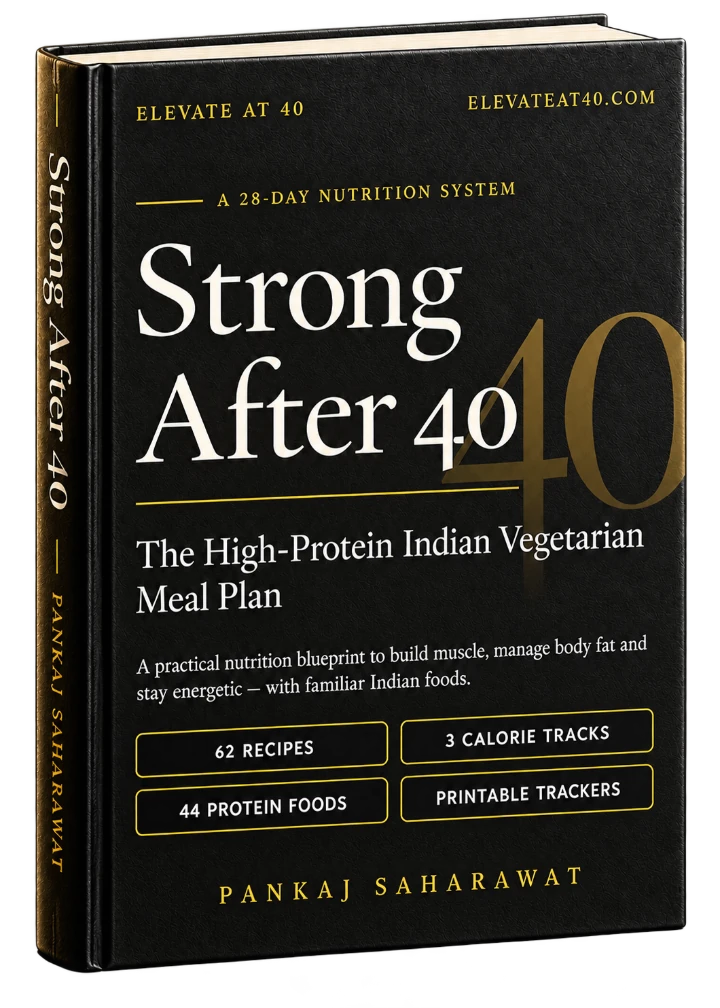
About Pankaj →Strong After 40
₹149- The 28-day plan on three calorie tracks
- 62 vegetarian recipes with nutrition strips
- 44 Indian protein foods compared
- Four weekly grocery lists and a batch-cooking guide
- Four printable planners and trackers
Questions
Is it fully vegetarian? Are there eggs?
Fully lacto-vegetarian: no eggs, meat or fish. It uses dairy, pulses, soya, besan and sattu. Vegan readers can follow it using the dairy-free chapter and swap table, and should discuss B12 and calcium with their doctor.
Is it only for men?
No. The three calorie tracks are written for smaller-framed women through larger, active men.
Do I need protein powder?
No. Every day reaches its target from whole foods. Powder appears as an optional convenience in a handful of recipes, each with a whole-food alternative.
Can I still eat roti and rice?
Yes. Every track includes both. The plan portions carbohydrate; it does not remove it.
Are nutrition values included?
Yes. Every recipe has a strip with kcal, protein, carbohydrate, fat and (where reliable data exists) fibre per serving. Values are estimates from IFCT 2017 and label data.
Can my family eat this food?
Yes — that is the design. Nothing is “diet food” cooked separately; portions change, the pot doesn’t.
How do I receive the PDF?
After payment, the checkout partner delivers your purchase — follow the confirmation email or download link it provides. Contact us if it doesn’t arrive.
Is it safe to eat this much protein?
For healthy adults with normal kidney function, intakes in this range are generally well tolerated. With kidney or liver disease, or diabetes or long-standing high blood pressure and unknown kidney function, have your reports reviewed first.